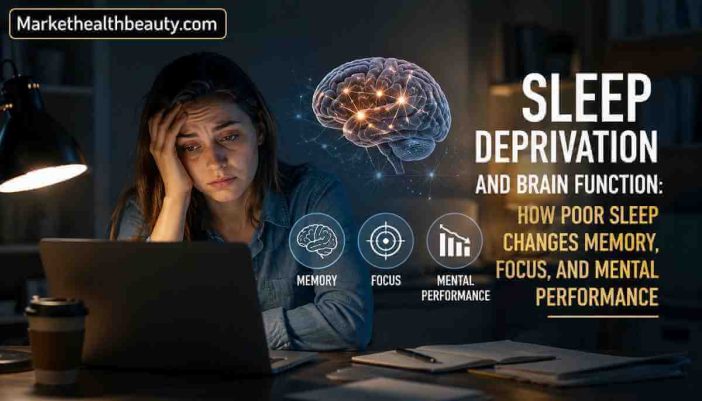
Most people recognize the feeling.
Coffee becomes less effective.
Names become harder to recall.
Tasks that normally require fifteen minutes stretch into an hour.
Patience disappears.
Conversations become harder to follow.
For many adults, these changes are accepted as part of a busy lifestyle.
The brain sees things differently.
Sleep is not downtime.
It is one of the most metabolically active periods of the day.
During sleep, neural circuits reorganize information, repair cellular damage, and clear accumulated waste products. When sleep becomes shorter, fragmented, or chronically insufficient, the effects extend far beyond simple drowsiness.
Why Sleep Matters for Brain Function
Sleep supports several biological processes essential for cognitive performance.
These include:
- memory consolidation
- emotional regulation
- executive function
- neural plasticity
- toxin clearance
- attention stability
Researchers increasingly view sleep as a fundamental pillar of long-term brain health.
People who experience persistent mental sluggishness may notice similarities with symptoms discussed in our article about brain fog and cognitive performance.
How Sleep Deprivation Affects Different Cognitive Systems
Memory Formation
New experiences are temporarily stored throughout the day.
During sleep, especially slow-wave sleep and REM sleep, the brain transfers important information into longer-term storage.
Poor sleep may result in:
- forgetting recent conversations
- difficulty learning new skills
- weaker recall during exams
- impaired professional performance
Executive Function
Executive function governs:
- planning
- organization
- impulse control
- prioritization
- decision-making
Studies suggest even one night of restricted sleep can reduce executive efficiency.
This overlap becomes particularly noticeable among adults already struggling with executive dysfunction in daily life.
Attention and Concentration
Sleep deprivation weakens sustained attention.
People often experience:
- increased distractibility
- slower reaction times
- reduced vigilance
- difficulty completing repetitive tasks
These changes resemble the effects produced by continuous digital interruptions.
Readers interested in this mechanism may also appreciate our discussion on digital distraction and attention fragmentation.
Emotional Regulation Suffers First
Many people assume lack of sleep primarily affects memory.
Emotional control often deteriorates sooner.
Sleep loss is associated with:
- irritability
- frustration
- mood swings
- heightened anxiety
- reduced stress tolerance
Neuroimaging studies suggest sleep deprivation increases amygdala activity while reducing communication with the prefrontal cortex.
The result is a brain that reacts more strongly while regulating emotions less effectively.
Brain Fog: One of the Most Common Consequences
Brain fog frequently emerges after repeated nights of poor sleep.
Common symptoms include:
- feeling mentally detached
- struggling to retrieve words
- reading the same paragraph multiple times
- losing track of conversations
- difficulty processing information
People often attempt to compensate using stimulants.
Unfortunately, caffeine cannot replace the restorative processes that occur during sleep.
Sleep Deprivation and Productivity
Productivity losses caused by insufficient sleep are often underestimated.
Examples include:
- poor meeting participation
- delayed decision-making
- increased workplace errors
- slower problem-solving
These challenges frequently contribute to decision fatigue and reduced workplace performance.
A related discussion is available in our article about ADHD and workplace performance.
Sleep and Brain Waste Removal
One of the most fascinating discoveries in neuroscience involves the glymphatic system.
During deep sleep, cerebrospinal fluid circulates more efficiently through brain tissue.
This process helps remove metabolic waste products.
Examples include:
- beta-amyloid proteins
- tau proteins
Both have been associated with neurodegenerative conditions.
Although occasional sleep loss is unlikely to cause permanent damage, chronic deprivation may increase vulnerability over decades.
A Practical Sleep Audit
Consider these questions.
Do you wake feeling refreshed?
Do you rely on caffeine throughout the day?
Do you sleep less on weekdays and compensate during weekends?
Do you frequently check your phone in bed?
Do you feel mentally slower by early afternoon?
Answering yes to several questions may indicate inadequate sleep quality.
A Simple Framework for Better Sleep
Protect Sleep Timing
Try maintaining similar sleep and wake times.
Consistency strengthens circadian rhythms.
Reduce Evening Stimulation
Limit:
- social media scrolling
- work emails
- bright screens
- heavy meals
Create Environmental Signals
Useful adjustments include:
- darker bedrooms
- cooler temperatures
- minimizing noise
- removing unnecessary electronics
Address Underlying Conditions
Persistent sleep difficulties deserve medical attention.
Potential contributors include:
- sleep apnea
- restless legs syndrome
- chronic pain
- medication effects
- depression
- anxiety disorders
Editorial Note
Many adults proudly describe functioning on four or five hours of sleep.
Short-term adaptation is possible.
Long-term optimization is different.
Brain performance depends less on pushing through fatigue and more on providing the conditions required for recovery.
This article is intended for educational purposes and does not replace professional medical evaluation.
Sleep Is an Investment in Future Cognitive Health
The effects of sleep deprivation rarely appear dramatic at first.
They accumulate.
One missed night becomes several weeks.
Several weeks become years.
Eventually concentration weakens.
Decision-making slows.
Mental endurance declines.
The encouraging part is that sleep remains one of the few cognitive interventions available to nearly everyone.
Better sleep may not solve every productivity problem.
But few interventions offer comparable benefits for memory, emotional balance, executive function, and long-term brain resilience.
Reference
- National Institute on Aging
- National Institute of Neurological Disorders and Stroke
- Harvard Medical School
- Sleep Foundation
- American Academy of Sleep Medicine