
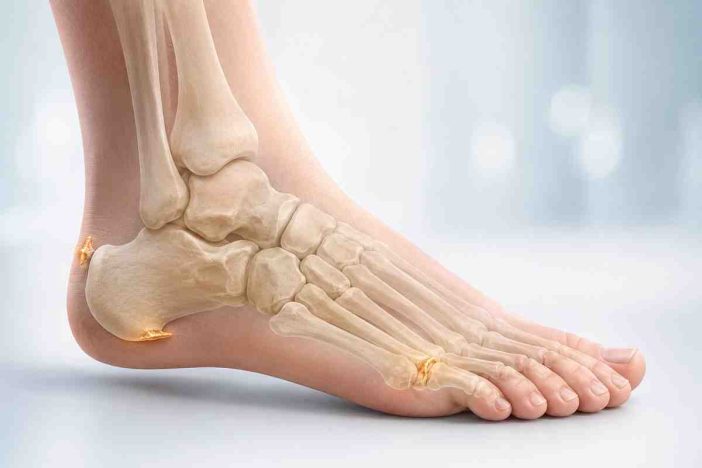
Bone spurs in the foot are extra areas of bone that develop along the edge of a bone or joint. Doctors may also call them osteophytes. They can form around the heel, the big-toe joint, the top of the foot, or areas where tendons and ligaments attach to bone.
Finding a bone spur does not automatically explain foot pain. Many people have heel spurs visible on an X-ray without experiencing symptoms. When pain is present, it may come from an associated condition—such as plantar fasciitis, arthritis, tendon irritation, or pressure from footwear—rather than from the bony growth alone.
Quick Answer
A foot bone spur is a bony projection that usually develops gradually in response to joint degeneration, long-term tension, or repeated irritation. Some cause no symptoms. Others may be associated with pain, stiffness, swelling, reduced joint movement, or irritation from shoes. Diagnosis depends on a medical history, physical examination, and sometimes imaging. Treatment focuses on the actual source of symptoms and usually begins with nonsurgical measures. Surgery may be considered when persistent symptoms substantially affect daily life and conservative treatment has not helped.
What Are Bone Spurs in the Foot?
Bone is living tissue that continually adapts to stress. In some locations, long-term joint changes or repeated tension where a tendon or ligament attaches can stimulate additional bone formation. The resulting projection is known as a bone spur or osteophyte.
Bone spurs are not the same as loose fragments of bone. They are connected to an existing bone and generally develop over time. They are often associated with osteoarthritis, but their cause and clinical importance depend on where they form.
A spur may be discovered accidentally during an X-ray performed for another reason. Whether it requires treatment depends on symptoms and the surrounding structures—not simply its size or presence.
Where Can Foot Bone Spurs Develop?
Foot bone spurs can develop in several locations.
Under the Heel
A plantar heel spur forms on the underside of the calcaneus, or heel bone, near the attachment of the plantar fascia. It may occur alongside plantar fasciitis. However, the American Academy of Orthopaedic Surgeons notes that most people with heel spurs do not have heel pain.
At the Back of the Heel
Spurs can form near the point where the Achilles tendon attaches to the heel. They may be seen with insertional Achilles tendinitis and can be irritated by pressure from the back of a shoe.
Around the Big-Toe Joint
Arthritis at the base of the big toe can produce bone spurs around the joint. This condition, often called hallux rigidus, may cause stiffness, pain while walking, and a bump that rubs against footwear.
On the Top or Sides of the Foot
Bony prominences can also occur near joints on the top or sides of the foot. Symptoms may develop when footwear presses on the area or when underlying arthritis limits joint movement.
Do Bone Spurs Actually Cause Foot Pain?
Sometimes—but not always. A bone spur may contribute to pain if it irritates nearby tissue, restricts movement, or creates pressure inside a shoe. In other cases, the spur is an incidental finding while a different condition causes the symptoms.
This distinction is particularly important with heel pain. Plantar fasciitis, stress fractures, Achilles tendon problems, arthritis, bursitis, and nerve irritation can produce overlapping symptoms. An X-ray showing a heel spur does not by itself prove that the spur is the source of pain.
If your main symptom is pain under the heel—especially discomfort that is worse with the first steps after rest—read our guide to plantar fasciitis for a closer look at that condition.
Possible Symptoms
Many foot bone spurs produce no symptoms. When symptoms occur, they depend on the spur’s location and the condition associated with it. Possible symptoms include:
- Localized pain or tenderness
- Stiffness or reduced movement in a nearby joint
- Swelling around the affected area
- A hard bump that can be felt beneath the skin
- Redness or irritation where footwear rubs against a prominence
- Pain that increases with walking, standing, or certain shoes
- Corns or calluses caused by repeated pressure
Burning, tingling, numbness, severe swelling, or sudden inability to bear weight should not automatically be attributed to a bone spur. These symptoms may have other causes and warrant professional assessment.
What Causes Bone Spurs in the Foot?
There is no single cause that applies to every foot bone spur. Common contributing conditions include the following.
Osteoarthritis and Joint Changes
Osteoarthritis can gradually alter cartilage and bone around a joint. Bone spurs are among the changes that may appear on an X-ray. In the foot, arthritis-related spurs commonly affect joints such as the base of the big toe.
Long-Term Tension at an Attachment Point
At the heel, a spur may develop where the plantar fascia or Achilles tendon attaches to bone. Longstanding tension at these attachment points can be associated with new bone formation.
Previous Injury or Repeated Irritation
Past trauma, chronic pressure, and repeated irritation may contribute to bony enlargement in some areas. Foot structure, occupation, activity pattern, and footwear can influence where pressure occurs, but they do not guarantee that a spur will form.
Age
Bone spurs become more common with age because degenerative joint changes accumulate over time. Nevertheless, age alone does not determine whether a spur will become painful.
How Doctors Diagnose a Foot Bone Spur
Diagnosis begins with identifying the true source of the symptoms. A healthcare professional may ask:
- Where the pain is located
- When it started
- Whether it is worse after rest or activity
- Which shoes or movements aggravate it
- Whether an injury occurred
- Whether there is a history of arthritis, gout, diabetes, or nerve problems
The examination may assess tenderness, swelling, skin irritation, joint movement, foot alignment, strength, and walking pattern.
X-rays can show bone spurs and may help identify arthritis or exclude certain fractures. Other imaging is not automatically required. It may be considered when symptoms suggest a soft-tissue injury, stress fracture, nerve problem, or another diagnosis that is not explained by the initial examination.
Avoid self-diagnosing a bone spur based only on a visible bump or the location of pain. Bunions, cysts, tendon disorders, fractures, and other conditions can resemble or accompany a bony prominence.
Nonsurgical Treatment Options
Treatment should address the condition causing symptoms. A painless spur usually does not require treatment.
Activity Modification
Temporarily reducing activities that aggravate pain may allow irritated tissue to settle. This does not necessarily mean complete inactivity. The appropriate level of activity depends on the diagnosis and severity of symptoms.
Footwear Changes
Shoes with sufficient room, cushioning, and support may reduce pressure on a painful area. A shoe that helps one condition may not be appropriate for another, so recommendations should be based on the spur’s location and the individual’s foot mechanics.
Pads, Heel Cushions, or Orthotic Devices
These devices may redistribute pressure or reduce irritation in selected cases. Custom orthotics are not necessary for everyone, and no device can be assumed to remove a bone spur.
Ice for Associated Soft-Tissue Irritation
Cold therapy may temporarily reduce discomfort related to irritated soft tissue. Protect the skin with a cloth and avoid prolonged direct contact with ice. Ice does not dissolve or remove a bone spur.
Physical Therapy
A clinician or physical therapist may recommend exercises to improve flexibility, strength, or movement when an associated tendon, fascia, or joint problem is present. Exercises should be selected for the diagnosed condition rather than applied identically to every type of foot pain.
Pain Medication
Some people may use over-the-counter pain relievers, but these medicines are not appropriate for everyone. Nonsteroidal anti-inflammatory drugs can cause gastrointestinal, kidney, cardiovascular, or medication-interaction problems. Follow the product label and ask a healthcare professional or pharmacist if you have medical conditions, take other medicines, are pregnant, or need pain medication repeatedly.
Medication may reduce symptoms, but it does not eliminate the bony growth.
When May Surgery Be Considered?
Surgery is not required simply because an X-ray shows a bone spur. It may be considered when:
- Symptoms remain significant despite appropriate nonsurgical care
- Pain or stiffness substantially limits walking or daily activities
- The prominence repeatedly irritates the skin or prevents suitable footwear
- The spur is associated with a joint or tendon problem that also requires treatment
The procedure depends on the location and underlying condition. It may involve removing a bony prominence, treating an arthritic joint, or addressing damaged soft tissue. Benefits, recovery time, restrictions, and risks vary by procedure and individual health status. A surgeon should explain these factors before treatment is chosen.
When to Seek Medical Care
Arrange an assessment if foot pain persists, repeatedly returns, interferes with walking, or does not improve with reasonable self-care. Seek more urgent care for:
- Sudden severe pain after an injury
- Inability to bear weight
- Rapidly increasing swelling or deformity
- An open wound, spreading redness, warmth, drainage, or fever
- New numbness, weakness, or marked color change
- Foot problems in someone with diabetes, poor circulation, or reduced sensation
These findings may indicate an injury, infection, circulation problem, or another condition requiring timely evaluation.
Bone Spurs Versus Plantar Fasciitis
Heel spurs and plantar fasciitis are related but not interchangeable.
A heel spur is a bony finding that can appear on an X-ray. Plantar fasciitis involves irritation and degeneration of the plantar fascia near its attachment to the heel. A person may have both, but the spur itself is often not the primary source of heel pain.
This is why treatment commonly focuses on the plantar fascia and contributing mechanics rather than automatically removing the spur.
Frequently Asked Questions
Can foot bone spurs go away on their own?
The bony projection generally does not disappear on its own. Symptoms can nevertheless improve when irritation and the underlying condition are properly managed. A spur that causes no symptoms may not require treatment.
Are foot bone spurs always painful?
No. Many are asymptomatic and discovered incidentally on imaging. Pain should be evaluated in context because nearby joints, tendons, fascia, nerves, or other structures may be responsible.
Can shoes cause bone spurs?
Shoes can create pressure and irritate an existing bony prominence. Footwear and repeated mechanical stress may contribute to symptoms, but it is usually too simplistic to identify shoes as the sole cause of a bone spur.
Can exercise make a foot bone spur worse?
An activity may worsen symptoms if it increases pressure on an irritated joint, tendon, or fascia. Appropriate activity modification depends on the diagnosis. Persistent or severe pain should be assessed rather than repeatedly exercised through.
Does every heel spur require surgery?
No. Most people do not need heel-spur surgery. Nonsurgical treatment is generally considered first when symptoms are related to plantar fasciitis or another soft-tissue condition. Surgery is reserved for selected cases after a clinical evaluation.
Bottom Line
Bone spurs in the foot are common bony changes, but their presence does not automatically mean they are causing pain. Symptoms and treatment depend on the spur’s location and the associated joint, tendon, fascia, or footwear problem.
A careful diagnosis matters because heel pain, big-toe stiffness, and visible foot bumps have several possible causes. Treatment usually begins with measures targeted to the underlying condition. Surgery may be considered for persistent, function-limiting symptoms, but it is not necessary for every bone spur.
This article provides general educational information and does not replace an examination, diagnosis, or individualized treatment from a qualified healthcare professional.
Sources
- American Academy of Orthopaedic Surgeons — Plantar Fasciitis and Bone Spurs
- American Academy of Orthopaedic Surgeons — Heel Pain
- American Academy of Orthopaedic Surgeons — Achilles Tendinitis
- American Academy of Orthopaedic Surgeons — Hallux Rigidus
- NHS — Osteophyte (Bone Spur)
- American College of Foot and Ankle Surgeons — Plantar Fasciitis