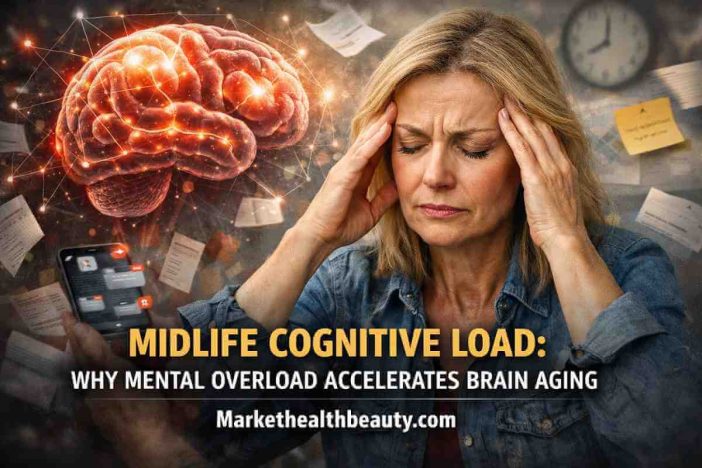
Why Midlife Is the Most Dangerous Phase for Cognitive Overload
Midlife cognitive load does not feel dramatic. There is no clear injury, no obvious loss. Instead, it manifests as relentless mental pressure—too many decisions, constant switching, unfinished cognitive loops.
This phase is dangerous precisely because:
- Performance still appears “normal”
- Capacity is silently eroding
- Recovery windows shrink unnoticed
By the time cognitive decline becomes visible, years of overload have already reshaped neural resilience.
This is why midlife matters so profoundly within Brain Health, Cognitive Longevity & Neuroprotection.
This pattern becomes especially important when viewed through the broader lens of Anti-Aging, Longevity & Healthy Aging, where protecting long-term cognitive function is inseparable from preserving overall independence and resilience.
What Cognitive Load Actually Means (Beyond Productivity Talk)
Cognitive load is not just “being busy.” It refers to the total demand placed on the brain’s executive systems—attention, working memory, emotional regulation, and decision-making.
In midlife, cognitive load spikes due to:
- Career complexity
- Family responsibility
- Financial decision density
- Constant digital interruption
Unlike physical fatigue, cognitive overload rarely triggers rest. The brain keeps working—at a cost.
How Chronic Cognitive Load Accelerates Brain Aging
Brain aging is not only biological. It is functional.
Chronic cognitive load accelerates aging by:
- Reducing neural recovery time
- Increasing baseline stress signaling
- Narrowing attentional flexibility
- Weakening executive control
Over time, this shifts the brain from adaptive mode to defensive mode, where resilience drops and error rates rise.
This mechanism explains why midlife overload often precedes later cognitive decline.
The Hidden Cost: Recovery Debt
The brain ages fastest when recovery is delayed or incomplete.
Midlife cognitive load creates recovery debt by:
- Fragmenting attention across too many contexts
- Preventing deep cognitive rest
- Sustaining low-grade stress activation
Recovery debt compounds silently. Each day seems manageable. Over years, the cost becomes structural.
This pattern aligns with the compounding logic outlined in Risk Accumulation Explained.
Cognitive Load vs Cognitive Challenge
Not all mental effort is harmful.
Beneficial Cognitive Challenge
- Structured
- Time-bounded
- Followed by recovery
- Builds resilience
Harmful Cognitive Load
- Continuous
- Fragmented
- Emotionally charged
- Lacks closure
Midlife environments disproportionately favor the second category.
Understanding this distinction is essential for Neuroprotection Strategy, where load management matters more than stimulation.
Why Midlife Cognitive Load Is Often Misdiagnosed
Midlife overload is frequently mistaken for:
- “Normal stress”
- “Burnout”
- “Aging anxiety”
In reality, it is a neurocognitive strain pattern.
Because there is no single symptom, the problem escapes detection. This is why Preventive Diagnostics Explained emphasizes trend awareness over thresholds.
Cognitive Load as a Longevity Risk Factor
Cognitive overload does not exist in isolation. It interacts with:
- Inflammation
- Metabolic stress
- Sleep disruption
- Emotional regulation
This interaction amplifies risk pathways described in Inflammaging Explained, where chronic stress accelerates systemic aging—including the brain.
In longevity terms, cognitive load is a risk multiplier.
Expert Insight: Cognitive Load Reduces Optionality Before Capacity
From longitudinal brain health reviews, one insight recurs:
Chronic cognitive load reduces optionality long before it reduces measurable ability.
People still function—but with fewer margins:
- Less tolerance for complexity
- Slower recovery from stress
- Narrower decision bandwidth
This loss of optionality is often irreversible if ignored too long.
Midlife Cognitive Load and Long-Term Independence
Cognitive independence depends on:
- Decision quality
- Attention stability
- Executive flexibility
Chronic overload erodes all three.
This is why Cognitive Longevity Risk treats midlife not as a neutral phase, but as a critical inflection point. Independence later is shaped here.
Practical Framework: Managing Cognitive Load Without “Hacks”
This is not about optimization tricks. It is about structural reduction of chronic strain.
Effective strategies focus on:
- Reducing decision density
- Creating cognitive closure
- Protecting uninterrupted focus
- Preserving recovery windows
These principles align with long-term decision logic outlined in Longevity Risk Management, where sustainability outranks intensity.
Technology, Attention Fragmentation, and Load Inflation
Digital tools increase capability—but also inflate load.
Unchecked, they:
- Multiply decision points
- Prevent cognitive completion
- Sustain low-level alertness
Within Medical Innovation, Diagnostics & Preventive Health Technology, technology must serve recovery—not permanently tax attention.
FAQ: People Also Ask
What is midlife cognitive load?
Midlife cognitive load refers to chronic mental pressure during midlife that strains attention, decision-making, and recovery systems.
Can cognitive load accelerate brain aging?
Yes. Persistent overload reduces resilience and accelerates functional brain aging.
Is cognitive load the same as stress?
No. Cognitive load includes attention fragmentation and decision density, not just emotional stress.
Can reducing cognitive load improve cognitive longevity?
Reducing chronic load improves recovery capacity and preserves long-term independence.
Bottom Line
Midlife cognitive load is not a temporary inconvenience. It is a long-term risk signal.
By recognizing how chronic mental overload accelerates brain aging, individuals can shift from endurance to design—protecting recovery, preserving optionality, and sustaining independence across decades.
Cognitive longevity is not lost suddenly. It is spent gradually. Midlife determines the rate.
Reference
- Long-term cognitive stress and resilience frameworks align with research summarized by the World Health Organization
- Cognitive aging and executive function research reflects perspectives from the National Institute on Aging