A supplement bottle can carry several persuasive symbols at once: a laboratory icon, a quality seal, the words “clinically studied,” and a promise of exceptional purity. On a shopping page, those details sit beside five-star reviews and a countdown for the next discount.
None of them answers the most useful question: Can you independently confirm what was tested in the product you are about to buy?
There is a difference between a manufacturer saying it tests its supplements, an independent laboratory reporting results for a sample, and a recognized certification program evaluating a product under defined requirements. Those distinctions matter when the product contains concentrated botanical extracts, multiple active ingredients, or nutrients that may be harmful in excessive amounts.
To verify third-party tested supplements, identify the certification or testing organization, search its official records, match the exact product and relevant batch information, and check what the program actually evaluated. If the claim cannot be confirmed, treat it as unverified rather than assuming it is false or trustworthy.
Here is a practical way to make that decision before spending money.
How to Verify Third-Party Tested Supplements in Five Steps
Step 1: Identify exactly what the label claims
Start with the specific wording, not the size or appearance of the seal.
A label might say:
- “Third-party tested”
- “Independently lab tested”
- “NSF Certified for Sport”
- “USP Verified”
- “Manufactured in a GMP-compliant facility”
- “Certificate of Analysis available”
These statements are not interchangeable.
“Third-party tested” may describe testing by an outside laboratory, but it does not automatically establish which tests were performed, how frequently products were sampled, or whether a comprehensive certification program covers the product.
A certification mark from a recognized organization is more specific because it refers to a defined program. Even then, you need to confirm the product’s status and the scope of the certification.
A claim that a product is manufactured in a facility following good manufacturing practices is also different from evidence that the exact finished product has passed independent testing.
First decision: Is the company naming a verifiable program, a laboratory, or neither?
If neither is identified, you have not yet obtained enough information to confirm the testing claim.
Step 2: Search the certifier’s official database
Do not stop at a logo printed on the bottle or displayed in an online product photograph.
Go directly to the certification organization’s website. Search using the brand and exact product name rather than relying on the manufacturer’s link alone.
Relevant starting points include:
- NSF Certified for Sport, which provides a searchable directory for its sports certification program.
- NSF’s supplement selection guidance, which explains its certification approach and links to product listings.
- USP’s official website, where consumers can find information about the USP Verified program and its product verification resources.
- Operation Supplement Safety, which provides independent educational guidance and a supplement screening scorecard.
Use the official site for the particular program named on the packaging. These programs have different requirements; passing one does not imply participation in another.
A real brand may sell both certified and uncertified products. The presence of one certified item does not establish that its entire catalog is certified.
Step 3: Match the exact product, not just the manufacturer
When you find a result in a certification directory, compare it with the bottle or online listing.
Check the following details where the registry provides them:
| Detail | What to compare | Why it matters |
|---|---|---|
| Brand | Full manufacturer or brand name | Similar brand names can cause confusion |
| Product name | Exact name on the bottle | Certification may cover only a specific product |
| Formula | Ingredients or formulation version | Products may be reformulated |
| Form | Capsule, tablet, powder, liquid, or gummy | Different forms may have different records |
| Flavor or variant | Specific version, where applicable | Not every variant necessarily shares coverage |
| Lot or batch | Printed batch number, where applicable | Certain programs and test results are batch-specific |
| Certification status | Current status and applicable program | An old label photograph may not reflect current coverage |
Not every directory publishes every field. An unavailable field is a reason to seek clarification, not automatic proof of a problem.
A partial match is not a verified match.
For example, a listing for an unflavored protein powder does not independently establish certification for a chocolate-flavored version unless that variant is covered by the program.
For products intended for drug-tested athletes, lot-specific verification is particularly important. The U.S. Anti-Doping Agency advises consumers to confirm relevant certification details rather than relying solely on a printed logo.
Step 4: Understand what the testing actually covers
A product may undergo laboratory testing without being evaluated for every possible concern.
Depending on the testing program, ingredient, and product category, assessments may address:
Identity: Whether the material contains the ingredient it claims to contain.
Potency or strength: Whether the tested ingredient amount is consistent with the product’s declared specification.
Contaminants: Whether specified contaminants, such as certain heavy metals or microorganisms, fall within the limits used by the applicable test.
Manufacturing controls: Whether facilities and quality systems meet the requirements of a particular certification program.
Prohibited substances: Whether a sports certification program screens for substances prohibited by relevant athletic organizations.
The testing scope matters as much as the fact that testing occurred.
A product could pass a heavy-metal panel while providing no evidence about the accuracy of its advertised active-ingredient amount. Similarly, general quality testing is not equivalent to screening intended for drug-tested athletes.
Do not interpret a passing laboratory result as a guarantee that every possible contaminant has been excluded.
Step 5: Check the health claim separately
This is the step many shoppers miss.
Product quality and clinical effectiveness are different questions.
Independent testing can provide evidence about characteristics of a supplement. It does not establish that taking the product will improve memory, reduce cholesterol, prevent illness, or produce a promised result.
The NIH Office of Dietary Supplements explains that quality seals do not guarantee a supplement is safe or effective.
The U.S. Food and Drug Administration also states that dietary supplements are not approved for safety and effectiveness before being sold in the same way that drugs undergo premarket approval.
Before buying, ask two separate questions:
- Quality question: Is there credible evidence that the tested product meets relevant manufacturing, ingredient, or contaminant specifications?
- Health question: Is there good clinical evidence that this ingredient, at an appropriate dose, provides the outcome I want—and is it suitable for me?
A satisfactory answer to the first question cannot substitute for the second.
Third-Party Tested vs. Third-Party Certified: What Is the Difference?
These terms often appear together, but they describe different levels of evidence.
| Claim | What it may establish | What you still need to check |
|---|---|---|
| Third-party tested | An external laboratory tested a sample | Laboratory identity, sample, scope, date, methods, and results |
| Third-party certified | A recognized program evaluated the product under its requirements | Official listing, product coverage, current status, and program scope |
| Batch-tested | A particular lot or sample underwent testing | Whether your lot matches and which tests were included |
| GMP or facility claim | Information about manufacturing practices or facility oversight | Whether it applies to the finished product and what was independently verified |
| Clinically studied | A reference to research involving an ingredient, formulation, or product | Whether the research applies to the specific supplement and advertised outcome |
Certification generally provides more structured oversight than an unspecified testing claim, but the strength of any conclusion depends on the actual program.
A manufacturer-provided laboratory report can be useful evidence. It should not be represented as independent certification unless it comes from a qualifying certification program.
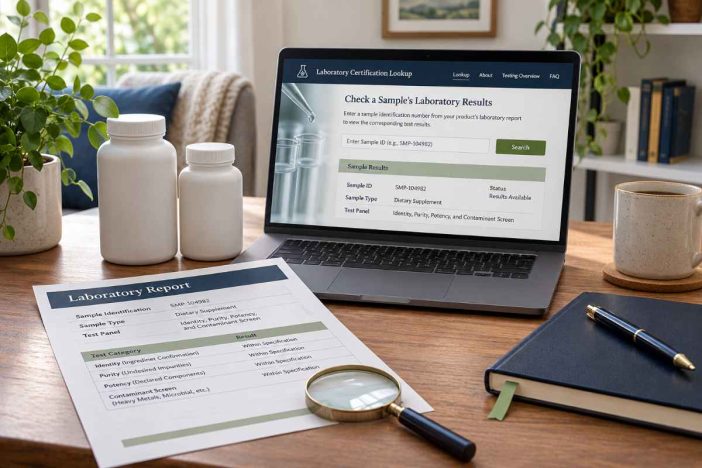
How to Read a Supplement Certificate of Analysis
A Certificate of Analysis (COA) is a document reporting analytical information for a product, ingredient, or sample. Its usefulness depends on what it identifies and what the tests cover.
When a brand offers a COA, examine six elements.
1. Product identity and sample description
Check whether the report concerns the finished supplement you intend to buy.
A COA for a raw botanical ingredient is not necessarily equivalent to a test of finished capsules containing that ingredient alongside other components.
2. Lot or batch number
Look for a matching lot number between the product and the report.
If the report covers a different lot, it may demonstrate the manufacturer’s past testing practices but does not verify the specific batch you are considering.
3. Laboratory and testing date
The report should identify who performed the analysis and when.
A laboratory named on a document is not automatically independent or accredited for every test it performs. If accreditation is claimed, verify the relevant scope where possible.
4. Test methods and specifications
A useful report makes clear what was measured and the criteria applied.
A column reading only “PASS” is less informative than a report that identifies the analyte, test method, measured result, applicable specification, and units.
5. Ingredient content and contaminants
Look for the tests that matter to the product.
For example, a botanical extract may raise questions about plant identity and standardized compounds, while a mineral supplement may call for attention to ingredient strength and relevant contaminant testing.
No single laboratory panel is universally adequate for every supplement.
6. Report authenticity and completeness
Check whether pages are missing, whether results have been cropped, and whether the laboratory can confirm the report if necessary.
A PDF with polished formatting is not proof of authenticity.
If the report is incomplete, the appropriate conclusion is “not verified from the information provided,” not automatically “unsafe.”
A Worked Example: Two Supplements With Similar Marketing Claims
Consider a fictional shopper comparing two magnesium products.
Both packages display the phrase “independently tested.”
Product A: A claim without an identifiable source
The product page says “third-party lab tested” but does not name a laboratory, certification program, or report.
Customer support provides a general statement that the company uses quality testing.
What can the shopper establish?
The company claims testing takes place. The available information does not allow independent confirmation of a particular product’s test results or certification.
Decision: Request verifiable documentation before treating the testing claim as confirmed.
Product B: A named certification with an exact match
The second product displays the name of a certification program.
The shopper searches the organization’s official directory and finds a listing matching the product name and relevant formulation. The shopper also checks whether the certification is current and whether the program covers the version being purchased.
What can the shopper establish?
There is independently verifiable evidence that the listed product participates in the specified certification program.
What remains unknown?
Whether that supplement is medically appropriate for the shopper, whether supplementation is necessary, and whether it will produce the advertised health outcome.
Decision: The quality claim is better substantiated, but the decision to take the supplement still requires separate consideration.
These are invented examples for teaching the verification method. They are not reviews or test findings about real products.
The Supplement Verification Checklist
Check each item as you verify the available information about a supplement. This checklist helps organize your research; it does not certify a product or establish medical safety.
Your selections remain in this browser session. Checking every item does not mean the supplement is safe, effective, or officially certified. No checklist data is submitted to a server.
You do not necessarily need every document for every purchase. The purpose is to identify the evidence that matters for the product and the risk involved.
For a basic nutritional product, reviewing an independent quality certification may be a practical starting point.
For a complex botanical mixture, concentrated extract, or sports supplement used by a drug-tested athlete, more detailed verification may be appropriate.
Red Flags That Deserve More Questions
Several warning signs deserve closer attention.
A certification logo without a matching record
A printed seal may be outdated, incorrectly applied, or unrelated to the exact product.
Check with the certification organization before concluding what happened.
“FDA approved supplement” wording
The FDA does not approve dietary supplements for safety and effectiveness before marketing.
A product claiming to be an FDA-approved dietary supplement should prompt additional scrutiny about what the company means.
A laboratory report for a different product or batch
A real test report can still be irrelevant to the product in your cart.
Confirm that its scope matches the claim being made.
“100% safe” or “zero side effects”
Testing does not eliminate the possibility of adverse reactions, interactions, allergic responses, or effects from inappropriate doses.
Claims that quality certification proves a medical benefit
An independently verified ingredient amount does not establish clinical effectiveness.
For more general background on supplements and their limitations, read our dietary supplement overview.
Apply the Verification Process to Different Supplement Types
The evidence you should request depends partly on the product.
Gummy vitamins
Gummies are convenient, but taste and texture are separate from nutrient accuracy and product quality.
When evaluating a gummy, compare the Supplement Facts panel with the specific product's quality information. Also consider the ingredient amount per serving, added sugars, and safe storage—especially around children.
Our guide to gummy vitamin supplements provides additional context about this format.
Organ meat supplements
Freeze-dried organ products are often marketed using claims about nutrient density and traditional food practices.
Ask whether any available testing covers the finished product and relevant ingredients or contaminants. Also examine nutrient intake, particularly when combining supplements with foods or other products containing similar vitamins and minerals.
For ingredient-specific considerations, see our organ meat supplements guide.
Multi-ingredient supplements
A product marketed for energy, focus, or men's health may combine numerous ingredients.
Even if the product has credible quality documentation, you still need to evaluate individual ingredients, their quantities, and possible interactions.
An apparently impressive ingredient list is not a substitute for an appropriate formulation.
Our men's supplement comparison illustrates the types of ingredients shoppers frequently encounter.
What to Ask a Supplement Company Before Buying
If the evidence is incomplete, ask a focused question rather than requesting an unspecified “lab certificate.”
You can send:
Could you identify the independent laboratory or certification organization for this exact product and formulation? If batch-specific testing is available, please provide documentation relevant to the lot being sold, including the tests performed and the applicable results or specifications.
A company may not disclose every proprietary manufacturing document. That does not automatically establish misconduct.
However, if your purchasing decision depends on independent verification and the available information cannot support it, choosing a more transparent alternative is reasonable.
When Certification Is Not Enough
Independent testing is valuable, but there are circumstances in which a healthcare professional's advice matters more than a quality seal.
Speak with a qualified clinician or pharmacist before using a supplement if you take prescription medications, have a significant medical condition, are pregnant or breastfeeding, are considering a product for a child, or are preparing for surgery.
Some products can interact with medicines, and the biological activity of an ingredient does not disappear simply because its manufacturing quality has been assessed.
For athletes subject to anti-doping rules, use the certification procedures recommended by the relevant sports authority and recognize that testing reduces risk rather than eliminating it completely.
If a supplement causes an unexpected reaction, stop using it and seek appropriate medical guidance.
Frequently Asked Questions
Can a supplement be third-party tested without being certified?
Yes. A manufacturer may hire an independent laboratory to analyze a product without participating in a formal certification program. The report may still be useful, but consumers should check the laboratory, sample identification, testing scope, and results rather than assuming the testing is equivalent to certification.
Does a USP or NSF seal mean a supplement works?
No. Quality verification and clinical effectiveness are separate questions. Certification may provide evidence about manufacturing, label accuracy, contaminants, or other program requirements. It does not establish that a supplement will treat a condition or deliver a particular health benefit for an individual.
What if a supplement is missing from the official certification database?
A missing result means you have not verified the claim through that search. Check spelling, variations, and the appropriate program, then contact the certification organization if needed. Absence from a directory does not, by itself, prove the product is contaminated, ineffective, or fraudulent.
Is a Certificate of Analysis enough to trust a supplement?
Not necessarily. A COA documents the analyses described in the report, sometimes for only one sample or batch. Its value depends on authenticity, laboratory independence, product matching, methods, and scope. It cannot replace a separate assessment of whether the supplement is appropriate or clinically useful.
A Better Buying Decision Starts With Verifiable Evidence
The most reassuring feature of a supplement label is not necessarily its largest seal or most confident marketing statement. It is the evidence you can independently trace to a specific product and a clearly described testing process.
When you verify third-party tested supplements, distinguish the company's claim from the certifier's record, confirm the product match, and keep quality testing separate from clinical effectiveness.
If the evidence is incomplete, you do not have to make a final judgment about the manufacturer. You can simply decide that you need more information before purchasing.
That is a more useful standard than trusting—or rejecting—a supplement based on the packaging alone.
Editorial note: This guide is based on publicly available regulatory and certification information. Market Health Beauty has not independently tested the products discussed in its examples. This article is educational and does not replace individualized medical or pharmaceutical advice.