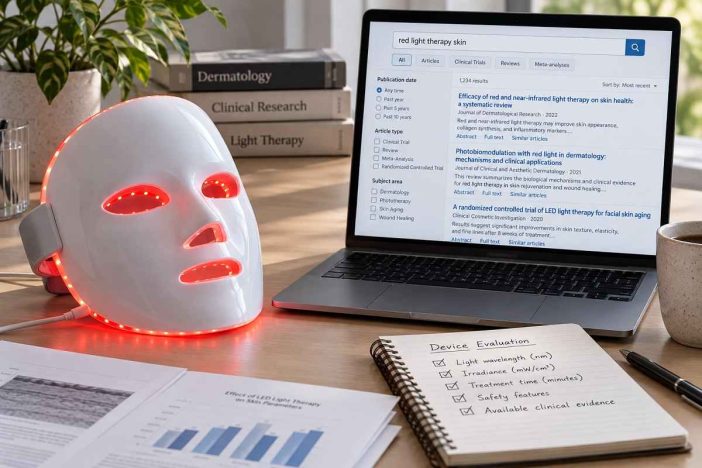
The product page has everything a shopper expects: a glowing mask, before-and-after photographs, and an impressive-looking FDA badge. What it may not have is a clear connection between that badge and the exact device being sold.
That connection matters. A clearance record can be genuine while the model, treatment area, or advertised benefit still needs checking.
The useful question is specific: can you follow the seller’s claim from the product listing to an FDA record that identifies the relevant device and use?
This guide shows you how to build that connection without turning a shopping decision into a regulatory research project.
What an FDA-cleared LED face mask claim means
For devices reviewed through the 510(k) pathway, FDA clearance involves a determination of substantial equivalence to a legally marketed predicate device.
That is a defined regulatory finding. It does not establish that a mask is the best available option, will produce a particular result for you, or supports every benefit mentioned in an advertisement.
“FDA-cleared” and “FDA-approved” describe different regulatory pathways. A seller using “approved” loosely should be able to identify the actual record supporting its claim.
“FDA-registered” is different again. Registration and device listing do not, by themselves, mean a product has received clearance or approval.
The FDA also states that it does not issue medical-device registration certificates. An official-looking certificate should therefore prompt a closer look at what the seller is actually presenting.
For the agency’s explanation, see its consumer guide to FDA registration and clearance.
Start with the product identity
Before searching any database, write down what you are buying.
Save the product page and collect:
- The retail brand and full product name.
- The model number.
- The claimed 510(k) number.
- The manufacturer or company identified in the documentation.
- The benefit you want the mask to address.
- A link to the user manual, if available.
The model number is particularly useful when a brand sells several generations or versions under similar names.
If the product listing does not show it, ask the seller for the model printed on the device label or packaging. A photograph of that label can be more useful than another marketing brochure.
Keep the intended benefit specific. “Facial wrinkles” gives you something concrete to compare with a regulatory document. “Younger skin” leaves much more room for interpretation.
Find the clearance record
Open the FDA’s 510(k) Premarket Notification database.
If the seller provides a 510(k) number, enter it in the number field. These identifiers commonly begin with K followed by six digits.
If no number is supplied, try the device name or applicant name. The applicant may differ from the retail brand, so an unsuccessful brand search is a reason to investigate further.
A database result is the beginning of the check. Open the individual record rather than relying on the search-result snippet.
Look for the device name, applicant, decision, and linked summary. Keep the record available alongside the seller’s product page so you can compare them directly.
Match the model before interpreting the benefits
A real record should not become a shortcut around checking product identity.
For example, FDA record K214101 identifies a Project E Beauty LED Light Therapy Mask and specifies model PE730. It also gives the applicant and a substantially equivalent decision.
The lesson is the specificity of the record. Finding that entry does not establish the status of every mask sold by the same brand or every similar-looking device.
Use three comparisons:
| Check | What to compare |
|---|---|
| Product identity | The retail product and the device named in the record |
| Model identity | The model on the label and the model in the documentation |
| Company identity | The brand, manufacturer, applicant, and any explanation connecting them |
If the names differ, ask for a written explanation that connects the retail model to the cited record.
A naming difference does not automatically show that a claim is false. It does mean the connection has not yet been established from the information in front of you.
Read the “Indications for Use” section
Once the identity matches, check what use the documentation actually describes.
In the FDA documentation for K250966, the CurrentBody Skin LED Light Therapy Mask Series 2 is identified as model MK-90H. The indications describe over-the-counter treatment of full-face wrinkles.
That is a useful worked example because it connects a product name, model, and specific use.
It does not make the same record evidence for every possible claim about that product. Claims about acne, pigmentation, hair growth, or other concerns need their own relevant support.
Watch for differences in:
- The condition or cosmetic concern.
- The body area.
- Home use versus professional use.
- Any population or use restrictions described in the documents.
If you are still deciding between a wearable mask and a stationary device, our comparison of LED face masks and red light panels explains how their coverage and everyday use differ.
That format decision is separate from verifying the regulatory claim attached to an individual product.
Do not confuse the subject device with its predicate
A 510(k) summary may compare several devices in the same table.
Identify which column describes the device covered by the submission and which describes its predicate or reference devices.
In the K250966 example, the summary distinguishes the subject model MK-90H from predicate model MK66R-B under K221946.
Reading across the wrong column can lead you to assign another device’s model or specifications to the product you are researching.
What to do when the model does not match
Pause the verification rather than guessing.
Send the seller the retail product name, label model, and clearance number it cites. Ask where the exact model is identified in the FDA documentation or what documentation connects it to the cleared device.
A useful response should let you follow the relationship. Repeating “FDA registered,” sending an unrelated certificate, or pointing to a similar mask does not resolve the model question.
For your own purchasing decision, use one of these outcomes:
| Outcome | Meaning | Next step |
|---|---|---|
| Documented match | The product identity and relevant use can be traced to the cited record | Continue evaluating suitability and value |
| Incomplete connection | A record exists, but the retail model’s relationship is unclear | Request supporting documentation |
| Unresolved claim | The supplied information does not establish the advertised clearance claim | Avoid relying on that claim when buying |
These are consumer verification outcomes, not legal determinations about a manufacturer.
An unsuccessful search also does not, by itself, prove a device is unsafe or illegally marketed. Regulatory requirements and pathways vary. The narrower conclusion is that you have not verified the particular claim.
Build a purchase record you can revisit
Keep a short note containing:
- Product name and label model.
- Seller and purchase-page link.
- Claimed clearance number.
- FDA record link.
- Relevant intended use.
- Any unresolved difference.
- The date you checked.
This is useful when a marketplace listing changes, a seller offers a different version, or the delivered product has a different model number.
Check the label again when the mask arrives. If it differs from the product you researched, contact the seller before treating the earlier verification as applicable.
Clearance does not finish the buying decision
Once you have verified the claim, you still need to decide whether the product suits your needs.
Read the manual, check the return policy, and look for evidence relevant to the exact outcome being advertised.
When a seller cites a clinical study, ask whether it tested the same device, what outcome it measured, and how the treatment was used. A paper about light therapy in general cannot answer every question about a particular retail mask.
Comfort and practicality also deserve attention. A device with an awkward fit or a routine you cannot maintain may be a poor purchase for your circumstances.
For the wider context, our guide to healthy aging and aging well explains why visible appearance is only one part of later-life health. A cosmetic device should not be treated as evidence of longer life or better overall health.
Our explanation of what longevity science studies provides further context for separating cosmetic outcomes from claims about lifespan and long-term function.
Check personal suitability before using it
Regulatory documentation cannot tell you whether light treatment is appropriate for your skin, medication, or medical history.
The American Academy of Dermatology’s red-light therapy guidance recommends discussing at-home treatment with a board-certified dermatologist, particularly when light sensitivity, skin conditions, or medications may affect suitability.
The association also highlights pigmentation concerns for darker skin tones and notes that long-term effects remain uncertain.
Follow the instructions supplied with the exact device. Use the specified eye protection when directed; do not substitute sunglasses for protective goggles.
This article explains a document-checking process. It does not provide a treatment schedule or replace individual medical advice.
Before buying, close the documentation gap
A useful FDA-cleared LED face mask claim should lead somewhere concrete: an identifiable device, a relevant record, and a documented intended use.
Start with the model. Find the record. Read the indication. Ask about any difference you cannot explain.
If that chain remains incomplete, you do not need to solve the manufacturer’s regulatory history yourself. You can postpone the purchase until the seller provides enough information to make the decision reviewable.