An LED face mask and a red light panel can use similar wavelengths, yet they deliver light to your skin in very different ways. The smarter choice is not automatically the device with more LEDs, a higher advertised power number, or the more expensive price tag—it is the one that delivers an appropriate treatment consistently to the area you actually want to treat.
This guide compares the two formats through seven practical differences: coverage, wavelength, irradiance and dose, treatment distance, convenience, safety, and long-term value.
Imagine standing in front of two devices that promise essentially the same thing.
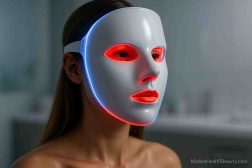
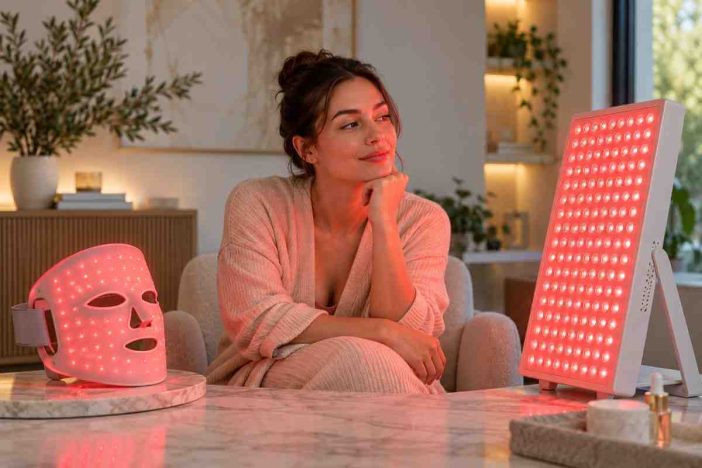
One is a flexible glowing mask that wraps around your face. You can wear it while sitting on the sofa, checking email, or listening to a podcast.
The other is a red light panel. It looks more industrial. Rows of LEDs illuminate your face from several inches away, and a larger unit might also cover your neck, chest, or much of your body.
The panel may look more powerful. The mask may look easier to use.
But appearance tells you surprisingly little about whether either device will provide a useful photobiomodulation treatment.
That is the real issue in the LED face mask vs red light panel debate.
Light therapy is not simply about exposing your skin to something red. Wavelength, irradiance, treatment time, distance, coverage, device design, and consistency all contribute to the exposure your skin receives.
That makes the best device a question of fit and measurable performance, not format alone.
Quick Answer: LED Face Mask vs Red Light Panel
For face-focused skincare and convenience, an LED face mask is often the more practical choice because the light source remains at a relatively consistent position around the face and the device is easy to incorporate into a routine.
A red light panel can make more sense when you want to treat the face plus larger areas such as the neck, chest, back, or body, or when you prefer a non-contact device.
However, neither format is inherently superior.
A well-designed mask can be more useful than a poorly specified panel, and a properly engineered panel can outperform a weak or poorly fitted mask for a particular application.
Before choosing either one, compare:
- intended use;
- wavelengths;
- irradiance at the treatment position;
- recommended session duration;
- coverage;
- treatment distance;
- eye-safety instructions;
- regulatory status where applicable;
- warranty and return policy;
- whether you can realistically follow the treatment schedule.
What Do LED Face Masks and Red Light Panels Actually Do?
Both devices may use photobiomodulation, sometimes called red light therapy or low-level light therapy.
Instead of heating or ablating tissue the way some cosmetic lasers do, photobiomodulation exposes tissue to specific bands of visible red or near-infrared light.
Clinical research has investigated several wavelengths rather than one universal formula.
For facial rejuvenation, studies have examined wavelengths including 630 nm, 633 nm, 660 nm, 830 nm, and 850 nm, among others. Some trials have reported improvements in measures of facial wrinkles after repeated treatment, but protocols vary substantially between studies.
That variation matters.
A device using a wavelength that appeared in a clinical study does not automatically reproduce the study’s result. The wavelength, irradiance, exposure time, treatment schedule, distance, device geometry, and population studied may all differ.
This is one reason shoppers should be skeptical of statements such as:
“Our device uses 660 nm, therefore it produces clinically proven results.”
A wavelength can be relevant without making every device that uses it clinically equivalent.
If you are new to the technology, first read our guide to LED face mask benefits to understand what at-home LED therapy can and cannot reasonably do for skin.
LED Face Mask vs Red Light Panel at a Glance
| Factor | LED Face Mask | Red Light Panel |
|---|---|---|
| Primary strength | Convenient face-focused treatment | Flexible coverage for face and larger areas |
| Position | Worn close to the face | Used at a specified distance |
| Coverage | Mainly face; some include neck accessories | Depends on panel size and positioning |
| Distance variable | Usually relatively fixed by design | User must usually maintain correct distance |
| Wavelength options | Often red and near-infrared; some add other colors | Often red and near-infrared, depending on model |
| Dose consistency | Depends on fit and device design | Depends heavily on distance and positioning |
| Hands-free use | Usually yes | Usually yes if mounted or positioned properly |
| Portability | Generally better | Small panels may be portable; large panels less so |
| Whole-body potential | Low | Medium to high depending on size |
| Buying priority | Fit, output, wavelengths, eye comfort | Output at distance, coverage, wavelengths, mounting |
Now let us look at the seven differences that actually matter.
1. Coverage: A Mask Follows the Face, a Panel Covers Space
The most obvious difference is also one of the most important.
An LED mask places light sources around the contours of the face. A panel projects light across a defined area from a distance.
LED Face Mask Coverage
A well-fitting mask has an obvious advantage for someone whose goal is primarily facial skincare: repeatable positioning.
You do not have to measure your distance from the device before every session. Put the mask on correctly, secure it according to its instructions, and the relative position of the LEDs is largely determined by the design.
But masks are not perfectly uniform.
Facial anatomy varies. The distance between an LED and the skin may differ around the forehead, cheeks, nose, jawline, and eye area. A rigid mask that fits one person well may sit farther from another person’s cheeks or press uncomfortably around the nose.
So “close to the skin” does not automatically mean “perfectly even coverage.”
Red Light Panel Coverage
A panel illuminates an area rather than following facial contours.
That can be an advantage if you want to expose:
- the face;
- neck;
- upper chest;
- shoulders;
- back;
- another larger treatment area.
A larger illuminated field can make a panel more versatile than a face-only mask.
The trade-off is that positioning becomes part of the treatment protocol.
Moving closer or farther away can alter the amount of light reaching the skin. Angling your face differently may also change exposure across facial contours.
Winner for Coverage
Face only: LED mask usually has the practical advantage.
Face + neck + chest or larger areas: panel usually has the advantage.
2. Wavelength Matters More Than Whether the Device Is a Mask or Panel
Marketing often frames the choice as mask versus panel.
Biologically, that is not the first question.
The first question should be:
What light does the device actually emit?
Red-light skin studies have used visible red wavelengths such as 630–660 nm, while other photobiomodulation protocols include near-infrared wavelengths such as 830–850 nm.
Visible red and near-infrared light have different optical behavior in tissue, but that does not create a simple rule that one wavelength is always “better.”
Your decision should begin with the intended use.
For Skin Aging
Look for a device specifically designed and documented for the cosmetic concern you want to address, rather than buying a general-purpose red lamp because its LEDs happen to glow red.
Clinical evidence for facial rejuvenation includes controlled trials of red-light and red-plus-near-infrared protocols, but the research does not establish that every consumer combination of wavelengths will produce identical results.
What About Blue Light?
Some LED masks include blue light, often marketed for acne.
That turns the product into a different comparison.
Blue-light acne treatment should not be assumed to perform the same role as red or near-infrared photobiomodulation for photoaging. Visible-light therapy also does not treat every type of acne lesion.
If acne is your main concern, choose a device specifically intended for that use and discuss persistent, cystic, or scarring acne with a dermatologist rather than selecting a device based only on the number of colors it offers.
Do More Colors Mean a Better Device?
No.
A mask advertising seven colors is not automatically more advanced than a device using one or two well-characterized wavelengths.
More modes are not evidence of better treatment.
A focused device with transparent specifications may be a better purchase than one that offers a rainbow of poorly documented settings.
3. Irradiance and Dose Are More Useful Than “Power”
This is where many red-light comparisons become misleading.
A manufacturer may advertise:
- high wattage;
- hundreds of LEDs;
- “medical grade power”;
- maximum intensity;
- extremely high irradiance.
Those figures may sound impressive, but more light is not automatically better.
What Is Irradiance?
Irradiance describes optical power delivered over an area, commonly expressed in units such as mW/cm².
Treatment exposure also depends on time.
A simplified relationship is:
Radiant exposure (J/cm²) = irradiance (W/cm²) × treatment time (seconds)
For example, purely as a mathematical illustration—not a treatment recommendation—an irradiance of 30 mW/cm² equals 0.03 W/cm².
If maintained for 600 seconds, the calculated radiant exposure would be:
0.03 × 600 = 18 J/cm²
But even that number does not tell you whether a treatment is optimal.
Photobiomodulation research describes a biphasic dose response: too little exposure may be insufficient, while simply increasing intensity or exposure indefinitely does not guarantee a larger biological benefit.
In other words:
Higher irradiance ≠ automatically better skincare.
Why This Matters for Panels
Panel output usually changes with distance.
If a company publishes an irradiance number, verify:
- at what distance it was measured;
- whether that is the same distance recommended for treatment;
- whether measurements were taken at the center or across the treatment area;
- whether independent measurements exist.
An impressive measurement at two inches may not tell you what reaches your face at twelve inches.
Why This Matters for Masks
Masks sit much closer to the skin, so treatment geometry is different.
But masks should still provide meaningful technical information. Do not assume proximity compensates for weak engineering or unclear specifications.
Practical Rule
Do not buy either format because one advertises a bigger wattage number.
Instead ask:
What exposure does the device deliver at the skin under the manufacturer’s actual treatment protocol?
That is the more useful question.
4. Distance Is a Major Variable for Panels but Less So for Masks
Imagine using the same red light panel on Monday from six inches away and on Wednesday from eighteen inches away.
You have not necessarily delivered the same exposure.
That is why distance is part of the protocol, not a trivial setup detail.
With a Panel
Follow the manufacturer’s specified distance.
Do not assume moving closer is better.
A closer distance can change intensity, illumination uniformity, comfort, and the size of the area covered.
Likewise, standing much farther away can reduce the exposure reaching the target area.
A panel therefore works best for someone willing to create a repeatable setup.
For example:
- Use the same chair or standing position.
- Set the panel at the same height.
- Maintain the recommended distance.
- Use the recommended treatment duration.
- Keep the treatment angle consistent.
With a Mask
The device largely determines the source-to-skin geometry once you put it on.
This removes one variable from daily use, which is a genuine convenience advantage.
That does not mean every part of the face receives identical light. It simply means the user has fewer positioning decisions to reproduce.
Winner for Simplicity
LED face mask.
Winner for Adjustable Treatment Geometry
Red light panel.
5. Convenience May Matter More Than a Small Specification Advantage
A technically impressive device that remains in a closet produces no benefit.
Red-light therapy generally requires repeated sessions over time rather than one treatment.
That makes adherence an underrated buying criterion.
Why Masks Can Win on Adherence
Many face masks are:
- wearable;
- hands-free;
- compact;
- easy to store;
- easy to integrate into an evening routine.
If the device takes only a few steps to use, a person may be more likely to follow the recommended schedule.
Why Panels Can Still Be Convenient
A panel can also be simple if you have a permanent setup.
For someone with a panel mounted beside a desk, bathroom mirror, or dedicated wellness area, use may be effortless.
But a panel that has to be unpacked, repositioned, measured, plugged in, and stored after every session creates more friction.
The Adherence Test
Before buying, ask yourself:
Can I realistically use this device according to its instructions for the next two or three months?
If the answer is no, its theoretical specifications matter much less.
This is especially important because controlled studies showing improvements in facial wrinkles typically involve repeated treatments across several weeks, not occasional exposure whenever the user remembers.
6. Safety and Regulatory Claims Need Careful Reading
At-home LED devices are generally marketed as non-invasive, but “non-invasive” does not mean every device is appropriate for every user.
Dermatologists recommend caution if you:
- have a condition that increases photosensitivity;
- take medication that increases sensitivity to light;
- have an active skin condition;
- have concerns about pigmentation;
- experience unusual pain, redness, or irritation after treatment.
People with darker skin tones may also want professional advice before using visible-light devices because visible light can contribute to pigmentation responses in susceptible skin.
Eye Protection
Follow the manufacturer’s eye-safety instructions.
If a device says protective eyewear is required, use the recommended protection every session.
Do not improvise simply because red light feels less harsh than ultraviolet light.
FDA-Cleared Is Not the Same as “Guaranteed to Work Better”
In the United States, a number of light-based over-the-counter wrinkle-reduction devices have received 510(k) clearance.
That is useful regulatory information.
But shoppers should understand what it means.
FDA clearance involves a determination of substantial equivalence within the applicable medical-device pathway. It should not be interpreted as proof that one cleared mask produces better cosmetic results than every uncleared competitor, nor should it be confused with an unlimited guarantee of effectiveness.
Be especially skeptical of vague phrases such as:
- “FDA certified”;
- “FDA registered, therefore clinically proven”;
- “medical grade” without a meaningful definition.
When a company makes a regulatory claim, verify the claim rather than relying solely on a product-page badge.
7. Cost Should Be Judged Against the Area and Purpose You Will Actually Use
Price comparisons can be deceptive.
A $300 face mask and a $500 panel do not necessarily compete for the same job.
A Mask May Offer Better Value If:
- your main goal is facial skincare;
- portability matters;
- you value a wearable design;
- you do not plan to treat the body;
- convenience will make you more consistent.
A Panel May Offer Better Value If:
- you want to treat the face and neck;
- you want chest or body coverage;
- multiple people may use the device appropriately;
- you have space for a permanent setup;
- a larger treatment field matters more than portability.
The relevant number is not simply purchase price.
Think about:
cost per useful treatment area × likelihood of consistent use × expected device lifespan.
A cheap device you stop using after two weeks is poor value.
An expensive whole-body panel is also poor value if you only wanted a convenient five- or ten-minute facial routine.
LED Face Mask vs Red Light Panel: Which Is Better for Wrinkles?
For facial wrinkles alone, there is no evidence-based rule that says a panel is inherently superior to a mask simply because it is larger.
Controlled research supports the broader concept that repeated red and red/near-infrared photobiomodulation can improve some measures of facial photoaging, and a 2025 randomized sham-controlled study reported improvement in crow’s-feet measures with a home-use mask combining 630 nm red LED and 850 nm infrared light over a 16-week protocol.
Other clinical studies have used different wavelengths, devices, and schedules.
That diversity is exactly why device format should not be treated as the deciding scientific factor.
For someone primarily interested in wrinkles, prioritize:
- device intended for facial rejuvenation;
- credible wavelength specifications;
- usable output information;
- clear treatment schedule;
- comfort;
- fit or positioning;
- safety guidance;
- realistic expectations.
MHB also has a separate guide to red light therapy devices for wrinkles if you are comparing devices specifically for signs of facial aging.
Are Red Light Panels Stronger Than LED Masks?
Sometimes.
But the statement is too broad to be useful.
A large panel may be capable of producing higher irradiance than a particular consumer mask. Another panel may produce lower exposure at the user’s treatment distance than expected. A mask may place lower-output LEDs very close to the treatment area and use a longer exposure time.
The correct comparison is therefore not:
Panel vs mask
but:
Device A’s treatment parameters vs Device B’s treatment parameters.
This distinction prevents one of the most common purchasing mistakes in the red-light market.
The 7-Point Device Verification Checklist
Before buying an LED mask or red light panel, collect answers to these seven questions.
1. What Is the Intended Use?
Does the manufacturer specifically describe:
- wrinkles;
- facial skin rejuvenation;
- acne;
- hair;
- pain;
- general wellness?
Do not assume a product designed for one purpose has been evaluated for another.
2. Which Wavelengths Does It Emit?
Look for actual wavelengths in nanometers (nm) rather than vague claims such as “deep red technology.”
3. What Is the Irradiance at the Treatment Position?
For panels especially, the measurement needs a distance.
“100 mW/cm²” without a measurement distance has limited value.
4. What Session Duration Is Recommended?
The treatment time should be tied to the device’s own protocol.
Avoid importing treatment times from another brand or an online influencer.
5. How Large Is the Effective Treatment Area?
Count useful coverage, not simply LED quantity.
A hundred LEDs pointed at a small area are not automatically better than fewer LEDs engineered for even coverage.
6. What Safety Instructions Are Provided?
Check:
- eye protection;
- photosensitivity warnings;
- contraindications;
- cleaning instructions;
- maximum use frequency.
7. Can the Regulatory Claims Be Verified?
If a product claims FDA clearance, look for enough information to verify the specific device or model.
Do not equate manufacturer registration with product-specific clinical validation.
To check a seller’s claim, follow our guide to verifying an FDA-cleared LED face mask, including how to match the model number and read the intended-use statement.
Red Flags When Shopping for Red Light Therapy Devices
Some marketing claims deserve extra scrutiny.
“The Most Powerful Device Is Always Best”
Photobiomodulation is dose-dependent.
Maximum output alone does not establish maximum benefit.
“More LEDs Means Better Results”
LED count says little without knowing wavelength, power distribution, geometry, treatment area, and protocol.
“Seven Colors Treat Seven Different Problems”
Different wavelengths can have different biological effects, but a colorful menu is not the same as clinical validation for seven separate indications.
“Results in One Session”
Skin remodeling processes take time.
Evidence for facial rejuvenation generally involves repeated treatment.
“Clinically Proven Technology”
Ask what exactly was tested.
Was the specific finished device tested, or is the company citing research about red light in general?
That is an important distinction.
Decision Tree: Should You Buy a Mask or a Panel?
Choose an LED face mask when most of these statements describe you:
- My priority is my face.
- Convenience is important.
- I want a wearable, hands-free treatment.
- I have limited storage space.
- I want a repeatable setup with fewer distance calculations.
- I am more likely to use a mask consistently.
Choose a red light panel when most of these describe you:
- I want to treat more than my face.
- Neck, chest, back, or body coverage matters.
- I have room for the device.
- I am comfortable maintaining the recommended distance.
- I want flexible positioning.
- Several treatment areas justify a larger device.
If both descriptions fit you, compare the individual products rather than deciding from form factor alone.
What We Would Check Before Spending $300–$1,000
Before paying premium-device prices, we would want to see a clear technical and consumer-information package.
That includes:
Wavelengths: clearly stated.
Output: measured in meaningful units and, for a panel, tied to distance.
Protocol: frequency and duration stated.
Indication: clear intended cosmetic or therapeutic use.
Eye safety: specific guidance rather than generic reassurance.
Warranty: enough coverage for an electronic device intended for repeated use.
Return period: particularly important with masks because facial fit and comfort vary.
Replacement policy: clear procedure if LEDs, straps, controller, or power components fail.
Regulatory wording: accurate and verifiable.
Clinical evidence: ideally device-specific; if not, marketing should distinguish research on the general technology from research on the exact model.
A company that hides basic specifications while making dramatic claims creates a simple problem:
You cannot meaningfully verify what you are buying.
How to Use Red Light Therapy More Safely at Home
Whatever format you choose, consistency should never replace caution.
Follow the device’s instructions rather than constructing your own aggressive protocol.
Start by confirming that the device is intended for your goal.
Use the stated treatment distance.
Respect the recommended treatment time.
Wear the prescribed eye protection when required.
Do not repeatedly extend sessions because you assume more exposure means faster results.
Clean a wearable mask according to the manufacturer’s instructions, especially where the device contacts skin.
If you develop persistent irritation, pain, unusual redness, or a change in pigmentation, stop using the device and seek appropriate medical advice.
And if you have a photosensitive condition or use medications that increase light sensitivity, discuss light therapy with a healthcare professional before beginning.
Can You Use Red Light Therapy With Retinol or Other Skincare?
Red light therapy is frequently used as one component of a skincare routine, but skin tolerance matters.
Do not assume that combining more treatments automatically produces better results.
If your routine already includes potentially irritating products such as:
- prescription retinoids;
- retinol;
- exfoliating acids;
- acne medications;
- strong peels;
follow your dermatologist’s advice and the light-device manufacturer’s instructions.
The main goal is to avoid turning a low-downtime treatment into an irritated skin barrier through unnecessary stacking of treatments.
How Long Before You See Results?
Red light therapy should not be judged after one or two sessions.
Clinical protocols evaluating facial rejuvenation have typically repeated treatments over weeks, and a recent home-mask trial followed users for 16 weeks.
That does not mean everyone needs exactly 16 weeks.
It means expectations should be aligned with gradual biological change rather than instant transformation.
Also remember that study results cannot simply be transferred from one device to another.
Different studies have used different:
- wavelengths;
- irradiances;
- doses;
- devices;
- schedules;
- endpoints;
- populations.
That is why promises such as “the study showed 30% improvement, so our device will give you 30% improvement” should be treated skeptically unless the specific device and protocol were actually studied.
Frequently Asked Questions
Is a red light panel more effective than an LED face mask?
Not inherently. Effectiveness depends on the individual device, its wavelengths, irradiance, dose, treatment geometry, intended use, and how consistently it is used. A panel’s larger size does not automatically make it better for facial skincare.
Is an LED face mask better for wrinkles?
A mask can be a very practical choice for wrinkles because it is designed around facial use and can provide repeatable positioning. Clinical research has reported improvements in facial aging measures using certain LED protocols, but results from one device cannot be assumed for every mask.
Does red light need to touch the skin?
No. Panels are designed to work from a specified distance. Masks are generally positioned very close to the face because of their design. What matters is following the tested or manufacturer-recommended geometry for the specific device.
Is higher irradiance always better?
No. Photobiomodulation has a dose-response relationship, and research describes a biphasic response in which simply increasing exposure does not necessarily improve results. Compare the complete protocol, not the maximum power number.
Are more LEDs better?
Not necessarily. LED quantity alone does not tell you wavelength, uniformity, irradiance at the skin, treatment area, or dose.
Is near-infrared light better than red light?
Neither can be universally declared better. Red and near-infrared wavelengths have different optical properties and have both been studied in photobiomodulation. Some facial devices combine them.
Should I choose an FDA-cleared device?
For U.S. buyers, verifiable FDA clearance for the intended use is a meaningful factor to consider. However, clearance should not be interpreted as proof that the device will outperform every alternative or guarantee a particular cosmetic result.
Bottom Line
The LED face mask vs red light panel decision becomes much easier once you stop asking which device looks more powerful.
For a person focused primarily on facial skincare, a well-designed LED mask may offer the best combination of convenience, repeatable positioning, and adherence.
For someone who wants to treat the face plus the neck, chest, or larger body areas, a properly specified red light panel may provide greater coverage and flexibility.
But format alone does not determine treatment quality.
Before buying either one, verify the wavelength, irradiance, treatment distance, exposure time, intended use, safety instructions, and regulatory claims.
Then consider the factor that specification sheets cannot measure for you:
Which device will you actually use correctly and consistently?
That is often the difference that matters most.
Sources and Further Reading
This article was informed by evidence and safety guidance from:
- American Academy of Dermatology — guidance on at-home red light therapy, device selection, safety, photosensitivity, and FDA clearance.
- U.S. Food and Drug Administration — 510(k) medical-device clearance framework and light-based over-the-counter wrinkle-reduction devices.
- Cleveland Clinic — clinical overview of LED light therapy and red light therapy.
- Mota et al., 2023 — randomized controlled trial evaluating photobiomodulation and periocular wrinkles.
- Lee et al., 2007 — randomized, placebo-controlled LED phototherapy study involving 633 nm and 830 nm wavelengths.
- 2025 multicenter randomized, double-blind, sham-controlled trial evaluating a home-use LED/IRED mask using 630 nm and 850 nm light.
- Hamblin and colleagues — photobiomodulation literature discussing irradiance, radiant exposure, and biphasic dose-response behavior.
Medical note: This article is for general educational purposes and is not a substitute for diagnosis or individualized treatment from a qualified healthcare professional.