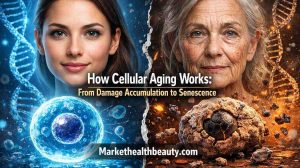

Inflammaging: When Protection Turns Into Pressure
Inflammaging describes a biological paradox: the immune system remains persistently active even when no acute threat is present.
Unlike acute inflammation—which is temporary and protective—inflammaging refers to low-grade, chronic inflammation that quietly persists over time. This state does not usually cause obvious symptoms, but it steadily influences how tissues age and how risk accumulates.
In longevity science, inflammaging is recognized as a core driver of age-related decline, linking cellular damage to system-wide dysfunction.
Why Inflammation Increases With Age
As the body ages, immune regulation becomes less precise.
Several factors contribute to inflammaging:
- Accumulated cellular damage
- Increased senescent cell signaling
- Changes in immune cell balance
- Reduced resolution of inflammatory responses
Instead of switching off after a threat passes, inflammatory pathways remain partially activated. Over years, this creates a background level of biological stress.
The Link Between Cellular Aging and Inflammaging
Inflammaging does not exist independently. It is closely tied to cellular aging.
As cells age:
- Damaged cells release inflammatory signals
- Senescent cells secrete pro-inflammatory molecules
- Repair mechanisms slow down
This creates a feedback loop: inflammation accelerates cellular aging, and aging cells amplify inflammation.
This interaction explains why inflammaging is often described as a systems amplifier rather than a single cause.
How Inflammaging Affects Tissues and Organs
Chronic inflammation alters how tissues function over time.
Long-term effects include:
- Reduced tissue regeneration
- Increased fibrosis and stiffness
- Impaired vascular flexibility
- Altered immune signaling
These changes do not appear overnight. They accumulate gradually, shaping the trajectory of aging across multiple organ systems.
Inflammaging and Healthspan
One of the most important insights in longevity research is that inflammaging influences healthspan more than lifespan.
Persistent inflammation:
- Reduces functional capacity
- Increases vulnerability to stress
- Accelerates decline without immediate disease
This helps explain why individuals may live longer but spend more years managing functional limitations—an issue explored further in Healthspan vs Lifespan.
Why Inflammaging Is Often Invisible
Unlike acute inflammation, inflammaging rarely causes pain or fever.
It is often:
- Clinically silent
- Slowly progressive
- Detected only through long-term patterns
Because symptoms are subtle, inflammaging can progress for years without attention—making early awareness critical in preventive frameworks.
Inflammaging as a Systems-Level Problem
Inflammaging affects and is affected by:
- Metabolic regulation
- Immune balance
- Vascular health
- Neurological signaling
This interconnectedness explains why chronic inflammation is associated with multiple age-related conditions, without being reducible to a single disease.
Within the Anti-Aging, Longevity & Healthy Aging framework, inflammaging is treated as a systemic process, not an isolated pathology.
Expert Insight: Why Suppressing Inflammation Is Not the Goal
A common misconception is that reducing inflammation entirely is beneficial.
From a biological perspective, inflammation is essential. The problem arises when resolution fails.
Effective aging strategies focus on:
- Improving immune regulation
- Supporting recovery cycles
- Reducing chronic inflammatory triggers
Longevity science emphasizes balance, not elimination.
Practical Perspective: Inflammaging and Long-Term Risk
Understanding inflammaging shifts how long-term health risk is viewed.
Instead of waiting for disease:
- Risk is recognized earlier
- Patterns are monitored over time
- Prevention focuses on system stability
This approach aligns closely with principles discussed in Chronic Disease Prevention & Risk Reduction, where chronic inflammation often acts as a shared underlying factor.
Inflammaging and Modern Health Monitoring
Advances in diagnostics allow researchers to observe inflammatory patterns more precisely than before.
Early detection and longitudinal monitoring—covered in Medical Innovation, Diagnostics & Preventive Health Technology—support a shift from reactive care to preventive insight.
Inflammaging, once invisible, is increasingly understood through trend-based observation rather than single measurements.
Common Misconceptions About Inflammaging
“Inflammaging only affects the elderly”
Inflammaging can begin earlier and progress gradually.
“Inflammation is always harmful”
Inflammation is protective when properly regulated.
“Inflammaging causes disease directly”
It increases vulnerability and risk, not certainty.
FAQ: People Also Ask
What is inflammaging?
Inflammaging is chronic, low-grade inflammation that increases with age and accelerates biological aging.
How is inflammaging different from acute inflammation?
Acute inflammation is short-term and protective; inflammaging is persistent and cumulative.
Does inflammaging affect longevity?
It primarily affects healthspan by accelerating functional decline.
Can inflammaging be reversed?
Inflammaging reflects long-term processes; some contributing factors may be modifiable.
Reference
- Chronic inflammation and aging concepts align with research summarized by the National Institute on Aging
- Systems-level inflammation frameworks are discussed in reports referenced by the World Health Organization
Bottom Line
Inflammaging is not a sudden malfunction—it is a slow, cumulative shift in immune balance that shapes how the body ages.
By understanding how chronic inflammation amplifies cellular aging and erodes resilience, longevity science reframes prevention as a long-term systems strategy.
Inflammaging explains why aging is not driven by a single cause—and why sustainable balance matters more than short-term suppression.