
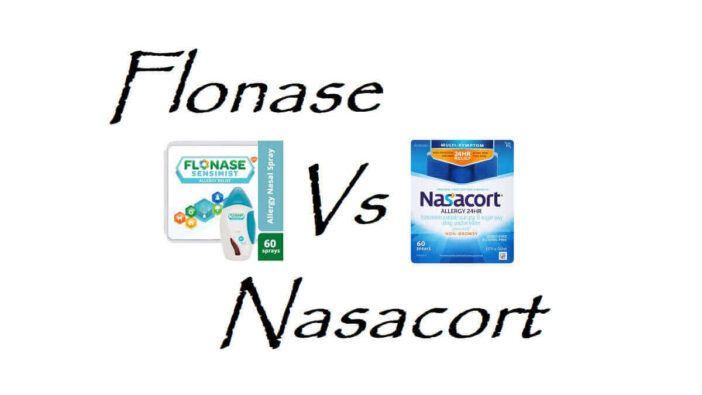
Flonase and Nasacort are over-the-counter corticosteroid nasal sprays used for allergy symptoms, but they are not the same product. Flonase Allergy Relief contains fluticasone propionate, while Nasacort Allergy 24HR contains triamcinolone acetonide. They also differ in their labeled age limits and the symptoms listed on their U.S. Drug Facts labels.
Neither spray is automatically “better” for everyone. The right choice depends on the symptoms you want to treat, the user’s age, medical history, other medicines, and how well the product is tolerated. Always follow the label on the exact package you purchase because formulations and directions can differ by product and country.
This article provides general education and does not replace advice from a doctor or pharmacist. Do not use both sprays together unless a qualified healthcare professional specifically recommends it.
Flonase vs Nasacort: Quick Comparison
| Feature | Flonase Allergy Relief | Nasacort Allergy 24HR |
|---|---|---|
| Active ingredient | Fluticasone propionate | Triamcinolone acetonide |
| Amount in each spray | 50 mcg | 55 mcg |
| Drug class | Glucocorticoid nasal spray | Glucocorticoid nasal spray |
| Labeled allergy symptoms | Nasal congestion, runny nose, sneezing, itchy nose, and itchy, watery eyes | Nasal congestion, runny nose, sneezing, and itchy nose |
| Youngest labeled age | 4 years | 2 years |
| Frequency on the U.S. OTC label | Once daily | Once daily |
| Maximum relief | Full effect may take several days of regular use | May take up to one week of daily use for the most relief |
The difference between 50 mcg and 55 mcg does not prove that one spray is stronger or more effective. These are different medicines, so their microgram amounts should not be compared as if they were the same active ingredient.
What Do Flonase and Nasacort Treat?
Both products are labeled to temporarily relieve nasal symptoms caused by hay fever or other upper respiratory allergies, including congestion, a runny nose, sneezing, and an itchy nose. Flonase Allergy Relief also lists itchy, watery eyes among its labeled uses. Nasacort’s Drug Facts label does not list eye symptoms.
These products are intended for allergy symptoms, not every cause of nasal congestion. Nasacort’s label specifically says not to use it for the common cold. The Flonase label advises medical review when symptoms do not improve within seven days or when new symptoms such as severe facial pain or thick nasal discharge develop, because the problem may be more than allergies.
If you are uncertain whether your symptoms are caused by allergies, start with our explanation of allergic rhinitis and consult a healthcare professional when symptoms are persistent, severe, or unusual.
Active Ingredients: Fluticasone vs Triamcinolone
Flonase Allergy Relief delivers 50 mcg of fluticasone propionate per spray. Nasacort Allergy 24HR delivers 55 mcg of triamcinolone acetonide per spray. Both active ingredients are glucocorticoids, a type of corticosteroid that reduces inflammation involved in allergic symptoms.
The products should not be treated as dose-for-dose equivalents. A pharmacist or doctor can help if you are changing products, if your current spray is not controlling symptoms, or if you use another steroid medicine for asthma, allergies, or a skin condition.
Age Limits and Label Directions
Flonase directions
The current U.S. Flonase Allergy Relief label says not to use the product in children under 4. Adults and children aged 12 or older use it once daily. The label directs two sprays in each nostril during the first week, followed by one or two sprays in each nostril once daily as needed during weeks two through six months. A doctor should be consulted before continuing after six months of daily use.
For children aged 4 to 11, the label directs one spray in each nostril once daily under adult supervision. Children should use it for the shortest time needed for relief, and a doctor should be consulted if a child needs it for longer than two months in a year.
Nasacort directions
The current U.S. Nasacort Allergy 24HR label says not to use the product in children under 2. For adults and children aged 12 or older, the label directs two sprays in each nostril once daily, reducing to one spray in each nostril daily after symptoms improve.
For children aged 6 to under 12, the label starts with one spray in each nostril once daily under adult supervision. It permits an increase to two sprays in each nostril daily if symptoms do not improve, followed by a reduction when symptoms improve. For children aged 2 to under 6, the label directs one spray in each nostril once daily under adult supervision. Consult the child’s doctor if use is needed for longer than two months a year.
These directions summarize specific U.S. OTC labels and are not individualized dosing advice. Follow the directions printed on your own package and do not use more than directed.
How Quickly Do They Work?
Neither product should be judged after only one spray. The Flonase label says some relief may begin on the first day, while the full effect may require several days of regular once-daily use. The Nasacort label says some symptoms may improve on the first day, but maximum symptom relief may take up to one week of daily use.
Nasacort’s label tells users to stop and speak with a doctor if symptoms have not improved after one week. Flonase provides similar advice when symptoms do not improve within seven days.
Side Effects and Important Warnings
Nasal irritation and nosebleeds can occur with corticosteroid nasal sprays. The labels for both products advise stopping use and consulting a doctor for severe or frequent nosebleeds or for changes in vision. Both labels also tell people with a history of glaucoma or cataracts to ask a doctor before use.
Children should use these medicines for the shortest period needed because corticosteroid nasal sprays may slow growth rate in some children. Use should be supervised by an adult according to the age-specific label.
- Ask a healthcare professional before use during pregnancy or breastfeeding.
- Ask before use if you have had recent nasal surgery, an unhealed nasal injury, or nasal ulcers.
- Discuss other steroid medicines and possible interactions with a doctor or pharmacist.
- Do not spray either product into the eyes or mouth.
- Do not share the bottle because doing so may spread germs.
- Seek medical help promptly for an allergic reaction, breathing difficulty, or other severe symptoms.
Flonase or Nasacort: Which One Should You Choose?
Flonase may be the more relevant label match when itchy, watery eyes occur along with nasal allergy symptoms, because eye symptoms appear among its labeled uses. Nasacort may be an age-eligible option for a child aged 2 or 3, while the Flonase Allergy Relief label begins at age 4. A parent should still discuss persistent symptoms and prolonged use with the child’s healthcare professional.
For users who are eligible for both products, the choice may depend on previous response, tolerability, inactive ingredients, price, availability, and advice from a pharmacist or doctor. There is no sound basis for declaring Nasacort better solely because it contains 55 mcg per spray or Flonase better solely because it contains 50 mcg.
Frequently Asked Questions
Is Nasacort the same as Flonase?
No. They belong to the same broad drug class, but Nasacort contains triamcinolone acetonide and Flonase contains fluticasone propionate. Their age limits and labeled symptom coverage are also different.
Can you use Nasacort and Flonase together?
Do not combine them on your own. Both are corticosteroid nasal sprays, and using two products from the same class may increase exposure without providing a proven benefit. Ask a doctor or pharmacist before combining, switching, or adding allergy medicines.
Is Flonase stronger than Nasacort?
The label amounts cannot answer that question. Fluticasone and triamcinolone are different active ingredients, so comparing 50 mcg with 55 mcg does not establish relative strength or effectiveness.
Can these sprays treat nasal polyps or a sinus infection?
Do not assume that the OTC allergy labels cover nasal polyps or an infection. Persistent blockage, severe facial pain, fever, thick discharge, recurrent bleeding, or symptoms that do not improve should be assessed by a healthcare professional.
When to Contact a Healthcare Professional
Contact a doctor or pharmacist before use when the user is pregnant or breastfeeding, has glaucoma or cataracts, recently had nasal surgery or injury, has an eye infection, or uses other steroid medicines. Seek advice if symptoms persist beyond the period stated on the label, and stop use for severe or frequent nosebleeds, vision changes, or an allergic reaction.
Bottom Line
Flonase and Nasacort are once-daily OTC corticosteroid nasal sprays with different active ingredients. Both treat common nasal allergy symptoms. Flonase also lists itchy, watery eyes, while Nasacort has a lower minimum labeled age. Use the exact product label—not the microgram number alone—to compare them, and ask a healthcare professional when symptoms, age, medical history, or other medicines make the choice uncertain.
Sources
- DailyMed: Flonase Allergy Relief Drug Facts, U.S. National Library of Medicine.
- DailyMed: Nasacort Allergy 24HR Drug Facts, U.S. National Library of Medicine.
Labels and recommendations can change. This article was reviewed against the cited U.S. Drug Facts records in September 2026.